Search This Blog

Monday, August 1, 2016

July 2016 Update

Dear Member:

July Weather

July daily high temperatures averaged 1 degree higher than normal at 100 degrees. The last week of July at an average high of 104 made the entire month seem warmer.  We received exactly the average rainfall of for the month, zero rainfall.  

Director Moi

Chris Moi announced his resignation from the Belmont Water Corporation board of directors at the last meeting.  He has accepted a new position and is moving with his family to the bay area. Thank you for your work on the board and best wishes to you and your family.  We'll miss you.

Well Inspection

The SWRCB inspected the well and tank in early July.  The recent installation of a concrete pad around the well head resulted in good report from the inspector.  

Watering Rules

Please water only three days per week, Tuesday, Thursday and Saturday. If you have a seasonal adjustment on your sprinkler controller, you should look to dial it back to the 80% level toward the end of the month as daily temperatures begin to cool. 

Water Conservation

Water usage was up again in July to almost 91,000 gallons per household, 12% worse than the target, and 13% worse than last year. For the year, we are still slightly better than last year at 2% better than the target but 1% worse than last year. July's usage was the highest monthly usage seen in the last 3 years.  The cost of electricity to pump our water was 69% over budget for the month of July.  Click here for a larger view.


Friday, July 1, 2016

June 2016 Update

Dear Member:

Happy Independence Day

Annual Consumer Confidence Report

The annual Consumer Confidence Report has been approved by SWRCB and has been uploaded  to the website. Click here to visit the Belmont Water Corporation Notices page.

June Weather

June was about 3 degrees warmer than average at 97 degrees and it appears that the warm weather spurred that usage of water (see below).  The month started and ended with triple digits, but gave us some nice days and a bit of rain in the middle. The Fresno Bee reports that we have received 14.29" of rain since the beginning of the weather year, last September 1, compared to a normal of 11.5".  

Water Sharing and the Well

The interconnection between BWC and BCC was closed on June 10 when repairs were completed to the BCC domestic well.  We have completed some minor improvements on the well, extending an air vent and pouring a larger concrete pad around the pump motor.  SWRCB will be inspecting the water system in July.  

Watering Rules

Please water only three days per week, Tuesday, Thursday and Saturday. If you have a seasonal adjustment on your sprinkler controller, it should be at the 100% level. 

Water Conservation

Water usage in June was up substantially to almost 89,000 gallons per household, 16% worse than the target, and 23% worse than last year. For the year, we are still slightly better than last year at 2% better than the target and 5% better than last year. Click here for a larger view.


Tuesday, June 7, 2016

Help devise a strategic Valley water plan


Fresno State is aware that water continues to drive daily discussions and concerns for San Joaquin Valley residents and all Californians. While this year’s average rainfall has taken the edge off the crisis for many, we still lack adequate water supplies, both in terms of quantity and quality, for the many needs of our region.

These issues will persist during the foreseeable future, and Fresno State is committed to providing the necessary leadership to assist in mitigating or alleviating impacts to Valley water concerns.

First, we are focusing on one of our region’s major issues – access to clean drinking water. Fresno State faculty, staff and students are actively working with California Environmental Protection Agency-designated Disadvantaged Communities to assist in mitigating water issues.

We have framed the need for a Center for Disadvantaged Communities at Fresno State and developed a white paper outlining its role to help small-community drinking-water and wastewater-treatment systems develop the tools necessary to protect the public health, safety and surrounding environment.

Second, we recognize the environment also needs water. Faculty researchers and students are busy studying the fate of water in the Sierra, the quality of water in our streams and rivers, and water needed in our Valley wetland areas. It is only by better understanding the water cycle of our region that we can appropriately take actions to meet various demands.

Third, while food production is part of our region’s heritage and should certainly be a major factor in our future, it is innovation that will provide the competitive edge. There are hundreds of water-technology companies in the Valley, many providing world-class technologies for a thirsty and hungry world.

Fresno State has a competitive advantage to assist businesses and entrepreneurs to strengthen the technology-based manufacturing sector.

Fourth, we know that building strong programs in water requires dedication, talent and funding. One such example is Fresno State’s recent award of $5 million from the California Energy Commission to establish the Central Valley Regional Energy Innovation Cluster.

Two campus entities, the International Center for Water Technology and the Lyles Center for Innovation and Entrepreneurship, are partnering to provide incubation services for entrepreneurs developing energy technologies for water, and connecting them with businesses and economic development organizations in the Central Valley and Northern California.

When fully operational, this effort will not only provide solutions for water and agricultural challenges, but also will create an economic base for employment and economic growth.

Many of our water efforts are being driven by the Report of the President’s Commission on the Future of Agriculture. In October 2014, Fresno State President Joseph I. Castro charged the Water Task Force to coordinate existing water-related programs and to redefine Fresno State as a recognized leader in the area of water technology, water resource management and policy.

A critical component of the report requires the development of a strategic plan for water. We are seeking everyone’s input – both academic and community interests – in this effort and hope you will take the opportunity to complete the short survey in a link at www.Californiawater.org. Your input will help shape the goals and direction that Fresno State takes for years to come.

The data collected from the survey will support the development of our Water Strategic Plan. It will provide a road map for the next five years that will guide the direction and effort for Fresno State.

While the opportunities for engagement in water issues appear unlimited, it will be important to appropriately rank the needs, assign the talent and engage the task. To optimize our success, we need the collective views of our community to be strongly reflected in the effort.

Our water future depends on community knowledge and engagement. In order for the region to achieve its goal of water sustainability, it will require the best minds to master our multiplicity of needs and requirements.

Fresno State is committed to attracting the best students and faculty, providing exceptional educational opportunities and engaging the challenges facing our communities to a successful completion.


Read more here: http://www.fresnobee.com/opinion/readers-opinion/article82282112.html#storylink=cpy

Wednesday, June 1, 2016

May 2016 Update

Dear Member:

May Weather

Well, it's once again summer in Fresno and it's heating up.

It was a very nice May with average high temperatures 2 degrees below the normal 86 degrees F.  Rainfall was .2" below normal at .29", but total accumulation for the year so far is over 14".  Enough rain has fallen to let the legislators take their eye off the ball with no new water storage facilities in construction or even planning.  And, Mr. Trump says, "There is no drought in California."

Water Sharing

The interconnection between BWC and BCC was closed on May 11 and reopened on May 27 when the electrical motor on the BCC pump quit working.  It has been repaired, but they are still experiencing issues with lack of air in the tank. We have kept the interconnection open, with no water flowing between the two pumps as they investigate a correction for their tank.  Once the tank is functioning properly we will again close the valves on both ends.

Annual Consumer Confidence Report

The annual Consumer Confidence Report has been submitted to the SWRCB for approval.  It should be ready for mailing sometime in June.

Neighborhood News

Jerry Murray, recovering from a recent surgery, fell and broke his leg.  We hope you feel better soon.  
Brock Montag decided he was ready to see the world and arrived early to parents, Ryan and Jessica.  Congratulations.  
Woody and Stephanie Salkin have purchased Doc Buchanan's home and will be moving in with their two young children by July 1.  Welcome to Belmont Country Club Estates.

Watering Rules

Please water only three days per week, Tuesday, Thursday and Saturday. If you have a seasonal adjustment on your sprinkler controller, it's time to move to the 100% level. 

Water Conservation

Water usage in May was up with the warming weather. Usage was great and 17% better than the target, but 1% worse than last year. For the year, we are 11% better than the target and 18% better than last year. Click here for a larger view.


Monday, May 16, 2016

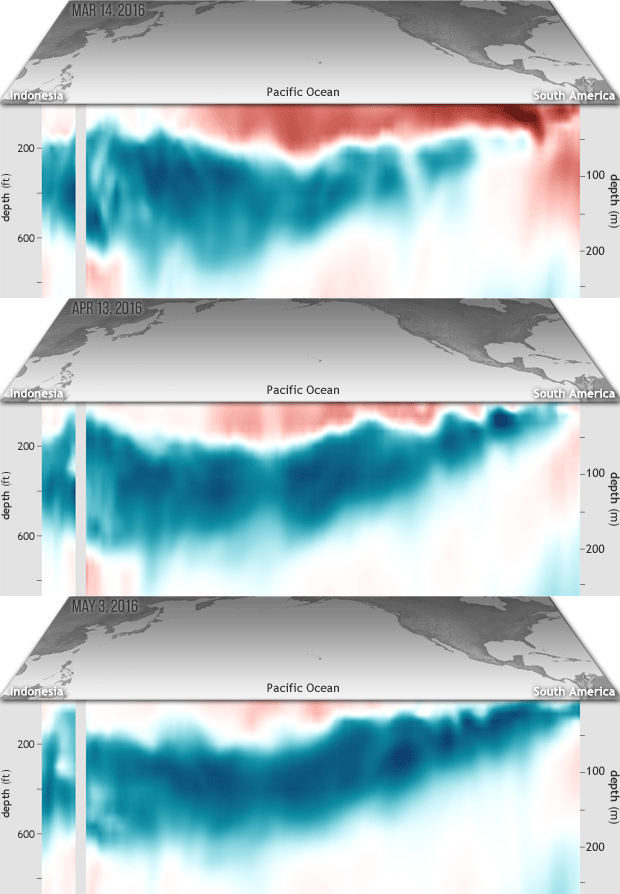
La Niña coming? Deep pool of cool water is making its way across tropical Pacific

One of the strongest El Niños on record has been dominating the tropical Pacific Ocean for the past year. But beneath the surface, a deep pool of cool water has been sliding slowly eastward for the past couple of months. This massive, slow-motion wave is a favorable sign that La Niña—the cool phase of the ENSO climate pattern—might develop.


Read more...

Monday, May 9, 2016

California water regulators propose major shift in drought conservation rules


Gov. Jerry Brown discusses his proposed 2016-17 state budget at a news conference at the California State Capitol Thursday, Jan. 7, 2016, in Sacramento.

Sacramento Bee
In a major shift in California’s urban water policy, state regulators Monday issued proposed conservation rules that would lift the mandatory 25 percent statewide water cuts in place since last June.
Instead, urban water agencies across the state would be required to conserve on a sliding scale tailored to their unique water supply conditions. A draft of the new targets released Monday by the State Water Resources Control Board would allow districts to “self-certify” how much water they expect to have in their supply assuming three additional years of drought, and the level of conservation necessary to ensure they do not run out of water.
The release of the draft rules came on the same day Gov. Jerry Brown issued a new executive order declaring that drought conditions persist and that the state must take permanent action to mitigate the likelihood of more frequent droughts.Districts would be required to reduce water use by an amount equal to their projected shortfall. For example, in a district where three more dry years would leave a district 10 percent short of anticipated supply, the mandatory conservation target would be 10 percent.
In the short term, the order tells the State Water Resources Control Board to adjust water conservation targets through January 2017.
The order also dictates that the water board and Department of Water Resources create new, permanent water use targets across California. Rather than the sweeping regulations in place over the last year, the order says those goals should be tailored to “the unique conditions of each water agency.
“It’s time for the state to “recalibrate our habits,” and change them “into an abiding ethic,” said Mark Cowin, director of the state Department of Water Resources.
Under the governor’s order, urban water districts will be required to report water use monthly to the state, extending a mandate that has been in place for more than a year. It permanently bans practices deemed wasteful, including hosing off sidewalks or driveways, washing cars with hoses that don’t have a shut-off nozzle, irrigating lawns in a way that causes runoff and irrigating lawns within 48 hours of precipitation.
“Californians stepped up during this drought and saved more water than ever before,” Brown said in a written release. “But now we know that drought is becoming a regular occurrence and water conservation must be a part of our everyday life.”
An El Niño weather pattern delivered more rain this water year than during any other year of the drought, but not as much as state officials had hoped. About three quarters of the state remains in severe, exceptional or extreme drought, according to the National Drought Mitigation Center.
Even so, the state’s two largest reservoirs –Shasta and Oroville – stand well above historic levels for this point in the year, as does Folsom Reservoir, leading some water districts to gripe the conservation targets currently in place are too high.
California water districts have faced mandatory conservation targets since June. From June to February, districts across the state were required to cut water use by 4 to 36 percent, depending on how much water per capita their residents used in 2014. All but a handful of districts in the Sacramento region were mandated to cut water use by 28 percent or more.
The targets were controversial. Soon after they were proposed, Sacramento area water districts began complaining that the one-sized-fits-all rules were onerous, didn’t account for variances in regional climate, and didn’t give enough credits to improvements some districts had made to shore up local water supplies.
In February, the State Water Resources Control Board relaxed the conservation mandates for many inland communities, where hot, dry summers make it harder to keep lawns and trees alive. Many of the water agencies in greater Sacramento saw their targets fall by 3 percentage points.
“We don’t want to cry wolf and we also don’t want to put our heads in the sand,” said water board chair Felicia Marcus.

Thursday, May 5, 2016

Inevitable changes in California’s water supply – from the Sacramento Bee

California faces major changes in its water supply. The sooner everyone realizes these changes are coming, the better the state will be able to cope with what lies ahead.

Today’s changes are driven by efforts to end groundwater depletion, by sea level rise and loss of snowpack, salts and nitrate accumulating in groundwater, new invasive species, population growth and California’s globalized economy and agriculture.